Bookmatching, and when it earns its place
The mirror-image detail every marble client asks about. When it is worth the cost and complexity — and when a single, honest slab does the same job for a fraction of the fee.
By Prestige Stoneworks Studio
In this article
Bookmatching is the detail people point to when they show us reference images. Two adjacent slabs cut from the same block, opened like a book, so the veining reflects across a central seam. On the right piece of stone it is dramatic, symmetrical and immediately memorable.
It is also expensive, slow, and sometimes the wrong call. This piece is about the second half of that sentence.
Where bookmatching works
Bookmatching earns its place on vertical, single-plane surfaces where the eye can read both halves at once — a fireplace surround, a shower wall, a bar back. The reflection is legible, the seam is a design feature, and the drama of the veining does what the client wanted it to do.
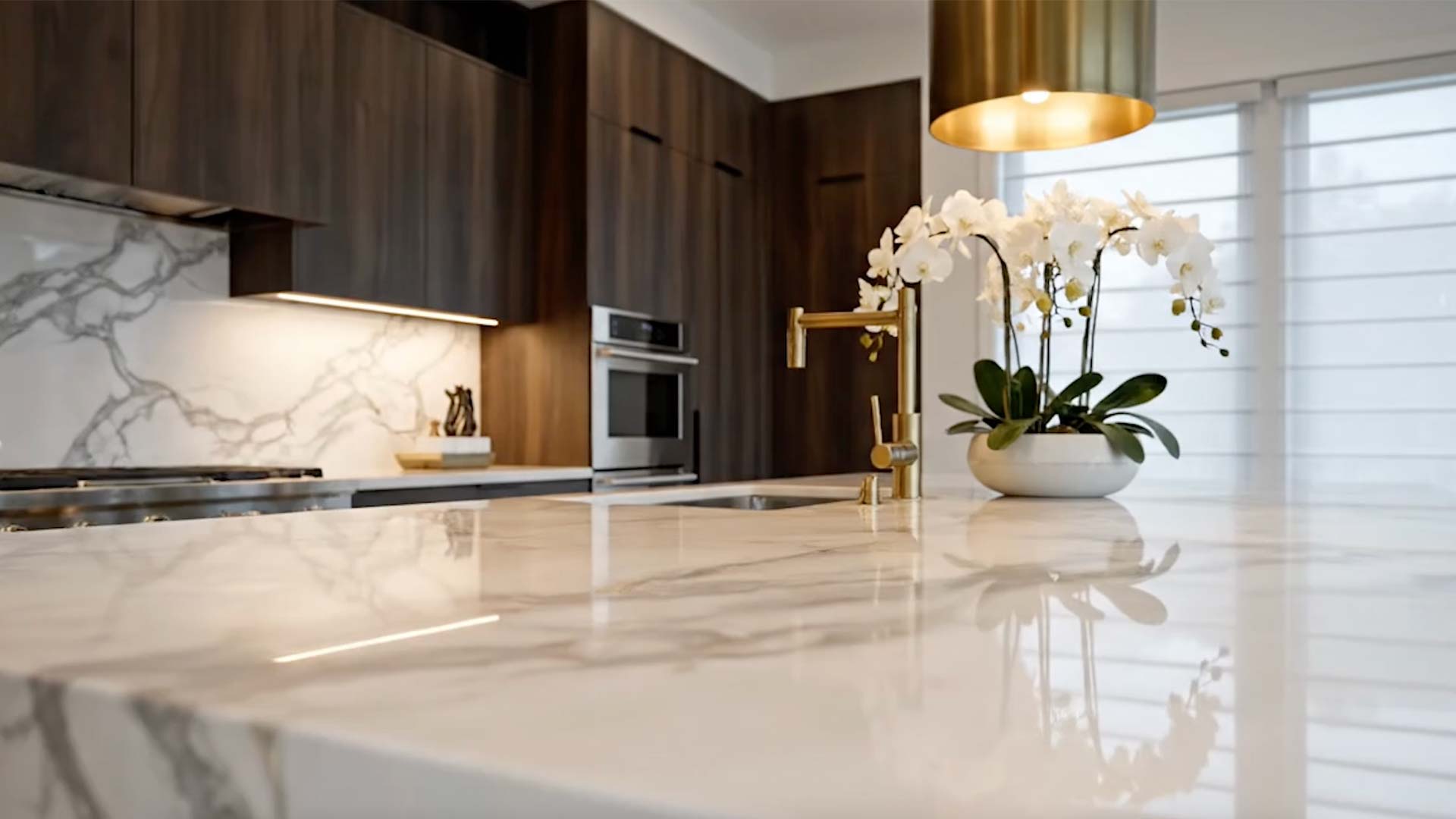
It also works on kitchen islands with waterfall ends, where the same slab wraps down to the floor and the vein reads as continuous rather than mirrored. Strictly speaking that is bookmatch plus a mitre — but it is the closest a horizontal surface gets to the same effect.
The technical requirements
- Slabs cut consecutively from the same block, kept in sequence
- Sufficient movement in the veining for the reflection to read
- A ground colour that will not shift between the two slabs
- A design that treats the seam as a feature rather than something to hide
Where a single slab is a better answer
On a long run of worktop, bookmatching often reads as busy rather than considered. The eye expects continuity in that context, not symmetry. A single well-selected slab, or two slabs sequenced so the veining flows in one direction, will usually feel more resolved.
Bathroom floors are another case. A bookmatched pattern on a floor plane fights with the walls, the sanitaryware and the joinery, and rarely looks better in life than it did in the moodboard.
What to ask for at the yard
When a project genuinely needs bookmatching, the specification starts at the yard, not on the drawings. We reserve slabs by number, mark up direction on the back with chalk, and photograph the layout on the workshop floor before any cutting starts.
The clients we work with are welcome to be part of that conversation — and are often surprised by how much of the final result is decided in a warehouse rather than a workshop.
Notes from the workshop
The honest case for engineered stone
Quartz and porcelain get a rough press in some design circles. This is the case for specifying them without apology — when they solve a real problem the client would otherwise inherit.
Specifying marble that lasts
How we help clients choose a marble that carries a room for decades — from block selection to the finish specified on the day of install.